Deadlines are not for High Performance
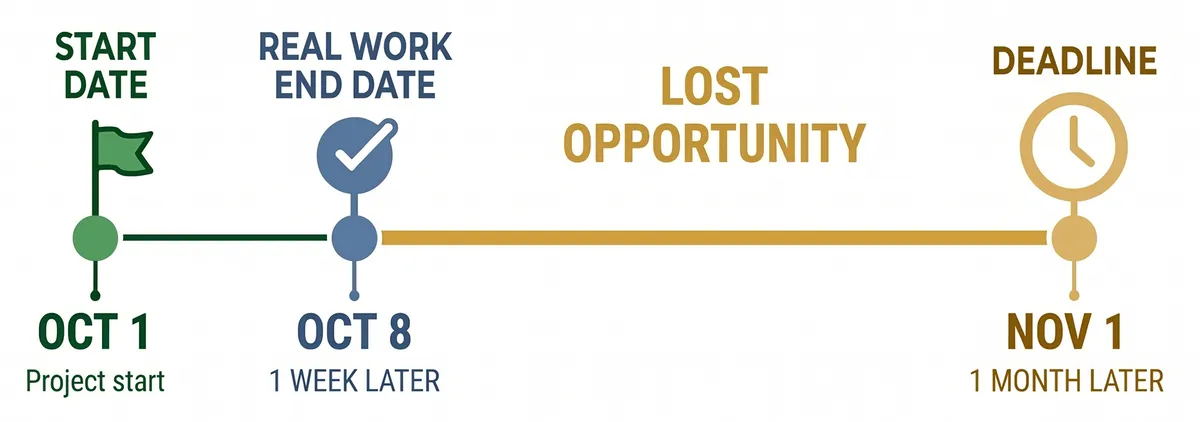
Deadlines work, but they work poorly. Deadlines pull people toward minimum performance rather than high performance, and thus rob both the organization and the person of achieving more. You may know the symptom as Parkinson’s Law: work expands to fill the time available. But to understand why it happens, and thus why deadlines work poorly, we need to understand how behaviors are shaped.
A behavior occurs due to an antecedent (i.e. stimulus) that enables it, and it is reinforced by its consequences (i.e. what immediately happens afterwards). This is referred to as the ABC of behavior: Antecedent -> Behavior -> Consequence.
A cue or situation
The action that follows
What happens next, which reinforces or punishes the behavior
A reinforcing consequence increases the frequency of the behavior (e.g. praise or reward for behavior), while a punishing consequence reduces the frequency of behavior (e.g. scolding or loss of future desirable opportunities). So let’s simplify the language and say that the behavior we want is “work” (e.g. coding, creating spreadsheets, filling orders), and thus ask: how do deadlines help get work done?
Deadlines establish a date, such that missing the deadline leads to a punishing outcome, thus the incentive is to work to avoid punishment. The avoidance of punishment is the driver. Now imagine a deadline actually has a lot of slack in it, e.g. the task can be done in 1 day but the deadline is in 7 days. Given the incentive structure, what is the incentive to finish before the 7 days? Nothing. If anything, most organizations punish the behavior of finishing early by assigning more work. So what does a rational person do? They finish just before the deadline, and to avoid other work being assigned to them in the meantime, they fill in the time somehow (e.g. exaggerate how hard the given task is). This lets the person exert the least amount of effort for the same reward: the avoidance of punishment.
A deadline looms, with an implicit threat for missing it
Do just enough work, finishing right before the deadline
Punishment avoided
Thus, a deadline achieves minimum performance. The organization loses the work it could have had, and the person loses too, through a gradual weakening of their skills and the absence of recognition for anything beyond the bare minimum.
Counter-argument: Set Better Deadlines
A common counter-argument is to “set tighter deadlines” and many managers argue that this is why it’s important to be “tough” to avoid anyone “cheating” by adding slack to their deadlines. Unfortunately, this does not address the root issue: it still fails to drive optimal delivery (aka. high performance); it only narrows the boundary of poor performance. This counter-argument has two distinct weaknesses:
- Unless the manager is an expert in the domain, and the task has significant certainty, it is not possible to know the shortest viable deadline. As such, even if, say, our 7-day deadline is negotiated down to 3 days, it is still a 2-day net opportunity loss since it could have been done in 1 day.
- Effort put into reducing poor performance could have gone into improving the environment and people’s skills to exhibit high performance.
Ultimately, focusing on a technique that lowers poor performance will underperform leadership that focuses on increasing high performance, yet many managers get this balance wrong.
What can you do differently?
You can take two measures:
- Separate the useful information in deadlines from the punishing nature of deadlines. Deadlines inform when a task needs to be completed due to a constraint (e.g. a contract); this is useful for everyone to know and can simply be articulated as “Required Completion Date”. The punishment in a “deadline” is mostly implicit and cultural, and the word itself signals a threat (with terrible origins). Reframing it as a date to plan around removes the threat while keeping the information everyone needs. Even if culturally you cannot stop using the word deadline, you can clarify your definition of it for your team to minimize its punishing nature.
- Prioritize your effort on techniques that achieve high performance, which provide incentive to finish sooner than the completion date. These can vary, such as recognition for finishing early, group incentives to finish early for a perk, or even the opportunity to work on interesting tasks once required tasks are done. Such effort incentivizes finishing early, and thus you may not even need a deadline.
Teams will then be incentivized to deliver as soon as possible, and you will negotiate dates less.