Stop Extinguishing High Performance

I have a parallel to the “If a tree falls in the forest, but no one is around, does it make a sound?” phrase that I keep in mind when managing:
A common approach among managers is to “Manage by Exception”. When something goes wrong, they prioritize it. And when something goes right, nothing happens.
This is the most damaging and expensive mistake a manager can make, because it extinguishes high performance. To understand why, we have to understand how behavior is shaped.
Behavior increases in frequency when it is reinforced by its consequences. This is true for behaviors small or large. For example, imagine one inconsequential light in a room suddenly burns out. On day one when you flick it on, it does nothing and you move on. On day two, you try again due to habit, nothing happens, and you move on. Eventually, one of the following days, you simply stop trying, because every time you did, nothing happened, so why would you try again? Your behavior to turn on the light has been extinguished due to a lack of a (reinforcing) consequence.
This pattern applies to every behavior.
You enter the room and want light
You flick the switch
Nothing happens, no reinforcement
Example: Hard work, slowly extinguished
Imagine you are emailed similar tasks to review week after week (e.g. an M&A plan, a Pull Request, a marketing draft):
You work hard to reply with detailed feedback, but then nothing happens.
You work hard again, and again nothing happens.
This time you start to take shortcuts since you have other things to do, and again nothing happens.
This time you simply skim it, and again nothing happens.
This time you barely spend effort on it, but this time the sender informs you they are unhappy with your work.
In week 5, you finally experience some consequence which influences your behavior going forward. Unfortunately, the feedback is not for your hard work, but it’s regarding your poor work, so it only helps you to figure out the minimum requirement for the task and thus increases the behavior to perform only at this minimum level (aka. week 4). Going forward, this will be your level of performance.
Why did this happen? Because hard work was extinguished due to lack of any recognition (reinforcing consequence), and only the minimum effort was recognized (reinforcing consequence) so it’s all that will persist.
Even more concerning is if minimum effort persists long enough to become a habit. Good luck attempting to manage people back to high performance. Don’t be surprised to hear “I’ve been doing it this way for a long time and there hasn’t been any issues, why do I need to do things differently?” with an occasional bonus challenge of hearing “Are you going to pay me more to work harder?”
What can you do differently?
Recognize high performance so that there is a reason for someone to exhibit high performance. And be specific about it so the individual knows what behaviors to do more of. This isn’t about handing out empty praise or participation trophies. Vague praise loses its meaning quickly; specific recognition does not.
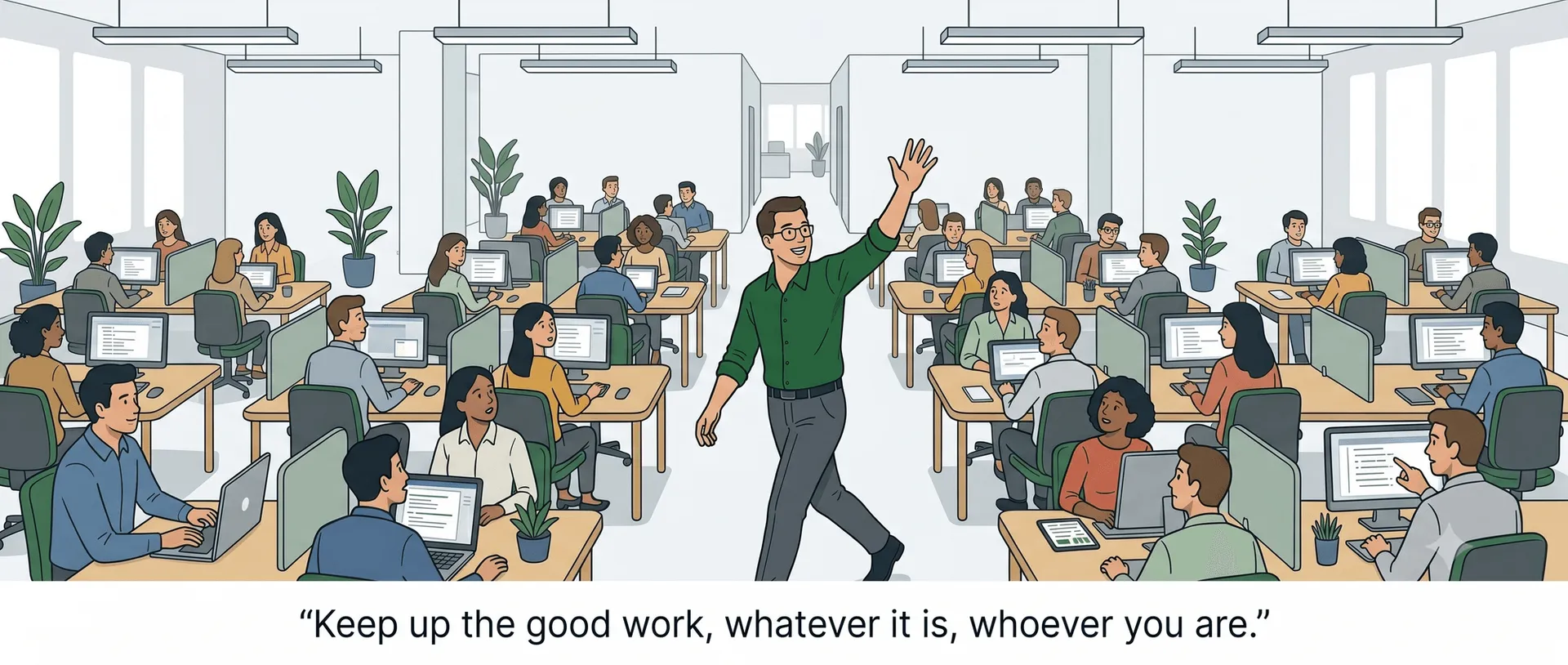
So rather than telling a person “Great job!”, be specific like the examples below.
Example: Recognizing a strong presentation
“Linda, I loved your presentation. Your agenda was clear and upfront specific and you had varied enough slide designs to maintain engagement specific. I appreciated how you kept the energy of the meeting high too specific.”
Example: Recognizing a well-drafted M&A plan
“Peter, this is a fantastic plan. Your research into the past acquisitions of this company and thus how we can ensure success with this upcoming M&A specific is very insightful. Your organization in the Excel documents, particularly with a starting sheet to explain it specific is awesome.”
Example: Recognizing a well-formed pull request
“Amy, that is some great code and architecture changes. I really liked how you updated our AI context and docs along the way specific, and took time to properly test using the right layers of the Testing Pyramid specific optimizing for correctness and speed by avoiding simply using E2E tests specific.”
Imagine you received such feedback yourself. Wouldn’t you want to repeat those specific behaviors? Wouldn’t you feel good for the work you did, especially because the hard parts of the work were recognized? That’s all it takes to avoid extinguishing high performance.
Whenever you positively recognize behavior, you increase how often it repeats, and whenever you negatively recognize it or ignore it, you decrease its frequency. Building high-performing teams is an active task.